Securing the Smart Home with Leading-Edge Technology
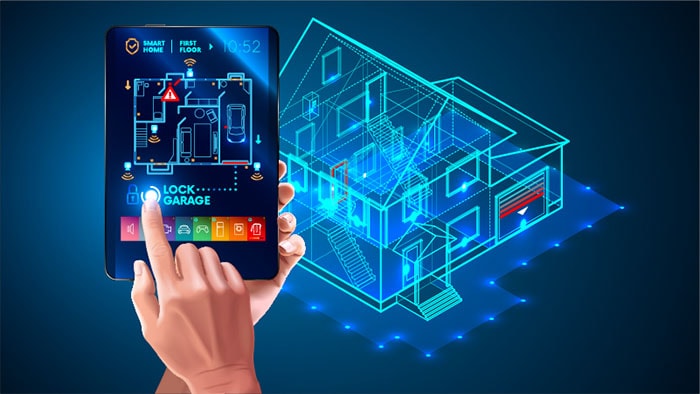
Image Source: Andrey Suslov/Shutterstock.com
Edited June 2, 2020 (Originally published May 1, 2019)
By Paul Golata, Mouser Electronics
Read the full EIT Home Automation eBook:
My third daughter recently graduated from college with an art degree. I had the opportunity to see her artwork
displayed in areas made to resemble a museum. Besides the artwork on the wall, museums always make me think of
security. If you are a fan of heist movies, you know that it always requires that the thieves employ ingenious
effort to get in and snatch the priceless treasure. They must maneuver through all sorts of security, laser beams,
motion detectors, pressure sensors, and the like. How awesome would it be if our homes had the same technical
advantages?
Home automation has evolved into the “connected home”—a broad system of home electronics that has
so much intelligence it can quickly repay owners for upfront investment costs through efficiency savings and in a
relatively short amount of time. The connected home promises to bring further automation into the home, linking
together disparate technologies, appliances, and devices and coordinating them into a synergistic platform to serve
homeowners, all within the control of their fingertips. As a simple and fully integrated system, home automation
offers home occupants’ peace-of-mind, which in today’s chaotic and turbulent world is of enormous
economic value.
One aspect of home automation that helps drive peace-of-mind involves home security and monitoring. Here,
we’ll describe how leading-edge innovation and electronic component technologies are supporting advanced smart
home security and monitoring solutions. These advances stem from new developments in electronics, technology, and
design areas involving power, sensing, compute, control, and communications. Home automation is conveniently
remaking the home environment—making it safer and more secure (Figure 1).
Figure 1: Managing smart home automation can be as simple as working a mobile
app. (Source: Mouser)
Security and Monitoring
Consider for yourself a home automation system that could provide security and monitoring along with a wide variety
of entertainment options. This home would incorporate infrastructures that can transmit and receive secure
high-speed internal and external communication. It would do so in a manner that both optimizes and minimizes home
resource consumption of utilities such as power, water, gas, and data. This automated home would have the
intelligence to allow it to act as its own steward over low-end tasks within the home, operating in a manner
analogous to a well-intentioned house sitter. This type of automated house would be both smart and connected.
Today’s electronic components have become more affordable while simultaneously increasing exponentially in
performance capabilities. Today’s communication infrastructures and services have become wonderfully
standardized, convenient, and ubiquitous. The integration of both passive and active semiconductors to produce these
complex infrastructures has brought forth a network so powerful that it equates to a personal, 24/7,
“around-the-clock,” electronic butler in your home, on your property. Automated homes consist of
multiple separate systems that one integrates to work together. In its simplest form, one might envision an entire
network as connecting in a manner as shown in the illustration in Figure 2.
Figure 2: Diagram of a connected home. (Source: AVX)
Because our focus is on security and monitoring, we will forego further discussion on the three other blocks in
Figure 2. The three areas that we will not discuss in this article include:
- Smart heating, ventilation, and air conditioning (HVAC) and smart lighting control
- Smart meters for utility monitoring
- Communication and entertainment
Before the development of the smart home, false alarms of intruder detection could account for up to 98 percent of
security triggers. This high level of false-positives is expensive and ends up producing a syndrome analogous to the
Aesop’s Fables classic, The Boy Who Cried Wolf.
Smart sensors now have wireless capabilities, allowing for their optimal placement around the home. Many smart
sensors have the requisite intelligence to ascertain what a true positive-alarm trigger condition is, thus avoiding
false-positives. Programming options through improved command and control products, like microprocessors, allow for
custom tailoring of sensors, especially for specifications such as sensitivity and multiple-confirmation triggers
that assist with improving accuracy in identifying a legitimate alarm trigger.
Occupant health monitoring is an expanding area of development with the creation of powerful accelerometer monitors
and motion/temperature sensors. Sensors have expanded to include monitoring water (H2O) leaks, carbon
dioxide (CO2) and carbon monoxide (CO) buildup, and other volatile organic compounds (VOCs). Likewise,
other important items that concentrate on the health and efficiency of systems such as HVAC performance relative to
specifications undergo monitoring as well.
Read more in the article: What IoT Developers Can
Learn from Smart Locks.
Power
Turning our attention to the four key technology-related design considerations of power, sensing, command and
control, and communications, which enable home automation security and monitoring, we will start by examining how
power management technology advancements are assisting in this effort.
Power management is a key design challenge in every Internet of Things (IoT) and home automation security product.
The ability to answer high-peak current demands and very lengthy, low-power system standby times requires solutions
that extend battery life. Electronic components manufacturers’ focus on offering a wide variety of products in
which electrical energy gets efficient utilization and distribution where it is essential.
Non-isolated direct current to direct current (DC/DC) and point-of-load (POL) power supplies function in security
and monitoring applications. On the input side, power can come in via wired-power options, often through
12VDC or using a battery-powered option, with the possible inclusion of supercapacitors—a type of
high-capacity capacitor—or often in the form of electric double-layer capacitors (EDLCs).
DC/DC power converters that adjust the input voltage to what the system needs to output are often in operation.
Designers working on such power converters might consider high-quality, synchronous buck converters, as they are
compact and easy-to-use. These parts can provide ample efficiency advantages over low-dropout (LDO) regulators.
When home automation systems use battery-powered devices, designers often employ step-down converters. These parts
assist with battery-based applications, as they are capable of drawing very low quiescent currents (IQs),
guaranteeing that the part will draw low currents from the battery when in a wait state.
Capacitors are key components for efficient power conversion. One common thread among high-efficiency switch-mode
power supply, microprocessor, and digital circuit applications is the need to reduce noise while operating at higher
frequencies. Specifically valuable for filtering, tantalum capacitor technology has many of the ideal
characteristics that DC/DC converters, power supplies, and other applications require. In home automation
applications, power-supply capacitors should exhibit many of the following positive characteristics:
- High capacitance retention at high frequencies
- Low failure rate
- Wide voltage range
- Surge robustness
- Environment (moisture/temperature) resistance
- Low cost
Power designs require protection against transient voltages. Using a capacitor is a common technique to control
transients and protect the circuit in voltage control designs. A capacitor can operate across the line/pin to
integrate the voltage and assist in the prevention of electrostatic discharge (ESD) damage. Engineers often
overestimate the performance of a standard multilayer ceramic capacitor (MLCC) because of the capacitor›s
significant value drop upon an applied ESD event. The introduction of supercapacitors, in the place of MLCCs, will
actually make a design more robust.
Sensing
Electronic systems allow security and monitoring systems to respond in changing situations, conditions, and
contexts. Sensors can signal door and window motions, smoke or CO presence, physical disturbances, pressure changes,
and more. These connected sensors offer a wide range of uses in smart home security and automation applications.
Whether through specific sensor components and related op-amps employed to enable battery-powered wireless devices
or through ESD protection for high-speed signal lines, engineers require a range of products to safeguard their
designs. Now, we will examine how sensor components and related solutions lead to excellent security monitoring
design.
Sensor devices provide real-time system protection, feedback control, and high accuracy system monitoring. Position
sensors enable engineers to determine absolute and relative positions, including angles, presence, proximity,
distance, flow, level, and velocity. Light and image sensors and sensing analog front end (AFE) help designers
capture a broad range of wavelengths.
Because your human eyes cannot be everywhere, it is helpful to have another set of eyes on your home to establish
extra protection. One option a designer might consider employing is an ambient light sensor. An ambient light sensor
measures the intensity of visible light. The spectral response of the sensor tightly matches the photopic response
of the human eye and includes significant infrared rejection (Figure 3).
Figure 3: Automated security entry systems on the gatepost of a residence.
(Source: APChanel/Shutterstock.com)
Still, looking for home intruders is not the only required sensing function in many security monitoring systems.
Often a change in the ambient environment warrants monitoring. A change in humidity might indicate that an
environmental shift is in process that can cause significant damage to valuables within a monitored location. In
such a situation, a humidity sensor can do the job. Humidity sensors can provide excellent measurement accuracy at
very low power levels and might also include an integrated temperature sensor.
In isolation, sensors alone might not be able to complete the job. Often sensors need a signal boost using
amplifiers so that downstream electronics can further manipulate and evaluate the sensors’ electronic
information. Ultra-low-power, operational amplifiers find employment in sensing applications with battery-powered,
wireless, and low-power wired equipment. Such ultra-low-power, operational amplifiers help to reduce power
consumption in equipment such as CO detectors, smoke detectors, and passive infrared (PIR) motion detectors where
operational battery life is critical.
Command and Control
At the core of any home automation security and monitoring application, there is a need to have command and control
over the electronic signals. A proper command and control system allows for the achievement of greater energy and
operational efficiency in the system. By incorporating products and technology with the brains to better monitor and
regulate systems, including lighting, windows and doors, video cameras, and more, a home becomes more safe and
secure for its occupants.
An effective way to utilize the command-and-control functions is to use a controller—specifically a
microcontroller unit (MCU). Microcontrollers are useful in embedded devices—as they contain the processor,
memory, and peripherals in one integrated unit. Many of today’s MCUs can excel at ultra-low-power sensing and
measuring. They allow designers to use a command-and-control platform from which to coordinate their design
requirements. Since they possess internal memory, both random access memory (RAM) and read-only memory (ROM), MCUs
are well-positioned to deliver fast, flexible, and reliable command and control functions without requiring
additional off-chip capabilities. Onboard memory and peripherals help MCUs minimize their total power consumption.
Communications
Home automation security and monitoring applications, of which the increasing need for wireless connectivity to
accommodate the Internet of Things (IoT) is driving, require a new dimension of wireless connectivity security. Upon
proper authorization, only where appropriate, data must undergo proper protection by allowing proper send and
receive transmissions.
Read more in the article: How IoT Short-Range
Connectivity Stacks up in Home Automation.
In home automation security and monitoring designs, wireless MCUs, which fully support
Bluetooth®, Zigbee, low-power wireless personal area networks (LoWPAN),
Thread, Wi-Fi, Sub-1GHz, Sigfox, or other protocols, must by design provide highly secure, cloud-ready solutions for
IoT accessibility. Additionally, wireless MCUs require an input voltage filtering/decoupling network and an output
impedance matching network for the radio frequency (RF) antenna.
Today, wireless MCUs can offer designers access to distinct wireless protocol modes. Wireless MCUs can offer a
blend of long/robust range, low power, and high data rates. By design, they often consume very low amounts of power,
allowing for battery operation. They might come with sensors that help them recognize when they should be active and
communicating or when they should be in a sleep or wait state.
Wireless MCUs give engineers greater flexibility, as these designers can consolidate the command-and-control
functions with the communication functions, ultimately to offer high levels of integration. Such levels of
integration will simplify designs and ensure continuously reliable communication.
Conclusion
Security and monitoring in the field of home automation continue to evolve. New electronic designs and solutions
continue to accelerate this trend. Now that many homes are automated, smart, and connected, electronic designers
need to continue to offer improvements on issues related to power, sensing, command and control, and communications.
A design engineer’s imagination is never automated. Consider how your imagination can take hold of the future,
and continue to make our future and our homes more convenient, secure, and safe.
 Paul Golata joined Mouser Electronics in
2011. As a Senior Technology Specialist, Mr. Golata is accountable for contributing to the success in driving the
strategic leadership, tactical execution, and overall product line and marketing direction for advanced technology
related products. He provides design engineers with the newest and latest information delivered through the creation
of unique and valuable technical content that facilitates and enhances Mouser Electronics as the preferred
distributor of choice. Prior to Mouser Electronics, he served in various manufacturing, marketing, and sales related
roles for Hughes Aircraft Company, Melles Griot, Piper Jaffray, Balzers Optics, JDSU, and Arrow Electronics. Paul
holds a BSEET from DeVry Institute of Technology in Chicago, IL; an MBA from Pepperdine University in Malibu, CA; an
MDiv with BL, and a PhD from Southwestern Baptist Theological Seminary in Fort Worth, TX. For questions, contact Mr.
Golata at paul.golata@mouser.com.
Paul Golata joined Mouser Electronics in
2011. As a Senior Technology Specialist, Mr. Golata is accountable for contributing to the success in driving the
strategic leadership, tactical execution, and overall product line and marketing direction for advanced technology
related products. He provides design engineers with the newest and latest information delivered through the creation
of unique and valuable technical content that facilitates and enhances Mouser Electronics as the preferred
distributor of choice. Prior to Mouser Electronics, he served in various manufacturing, marketing, and sales related
roles for Hughes Aircraft Company, Melles Griot, Piper Jaffray, Balzers Optics, JDSU, and Arrow Electronics. Paul
holds a BSEET from DeVry Institute of Technology in Chicago, IL; an MBA from Pepperdine University in Malibu, CA; an
MDiv with BL, and a PhD from Southwestern Baptist Theological Seminary in Fort Worth, TX. For questions, contact Mr.
Golata at paul.golata@mouser.com.